
Artificial Intelligence and Student Academic Development: Use, Perceptions and Concerns Among Final Year Students in the Department of Development Studies, Midlands State University, Zimbabwe
The rapid uptake of Artificial Intelligence (AI) within higher education in Africa represents a significant technological shift with implications for teaching, learning and student academic development. This study examined how undergraduate students use AI tools and how they perceive the effects of AI on their academic development. A mixed-methods design was employed at a selected public university in Zimbabwe, combining a cross-sectional student survey administered through the KoboToolbox (69 valid responses) with qualitative input from in-depth interviews and observation. The findings show near-universal awareness of AI, with use led by general-purpose tools (ChatGPT, 59.4 percent) and access dominated by personal laptops (85.5 percent). Students used AI mainly to understand difficult concepts and generally rated it at least moderately effective for their academic development, while also voicing substantial concerns about the accuracy of AI-generated information, over-reliance and the weakening of critical-thinking skills, the cost of advanced tools, and academic integrity. The most commonly reported negative consequence was reduced effort in personal research. The study advocates institutional action beyond mere technology adoption and recommends a clear, ethical AI policy and continuous staff professional development to support the responsible use of AI. The study extends a recent qualitative case study on the same university by Gawe & Gudyanga (2025) by adding survey-based evidence on patterns of use, access, cost and self-reported negative consequences. As a small, single-institution, cross-sectional and descriptive study, it does not establish causal or statistically significant associations between AI use and psychological outcomes such as stress or anxiety.
Keywords: academic development, artificial intelligence, higher education, student perceptions, technology adoption, Zimbabwe
Revista de Pedagogie Digitala – ISSN 3008-2013
2026, Vol. 5, Nr. 1, pp. 50-60
https://doi.org/10.61071/RPD.2693
HTML | PDF
Introduction
Globally, the use of Artificial Intelligence has gained momentum, particularly in the education sector. In developing countries such as Zimbabwe, the use of AI for learning and academic development is relatively new, even though AI as a field is some seventy years old (Crawford et al., 2024). There is, however, an intellectual cleavage on the effects of AI in education, with scholarship divided along an optimism-pessimism continuum. On the optimistic side, AI tools such as chatbots, adaptive learning platforms and writing assistants are credited with widening access to information and supporting personalised, more efficient learning (Holmes et al., 2019). On the cautionary side, Gu and Zhou (2023) argue that the rapid advance of smart media carries risks for students, including concerns about personal information leakage, social media-related anxiety, online dependency, and unease that intelligent systems may displace employment opportunities. These competing positions frame the need to understand how students actually use AI and how they perceive its effects on their academic development.
Chen et al. (2024) note the potential of AI to support learning through customised assistance, while cautioning that it can also introduce new pressures. Students face a range of challenges as they adapt to AI-driven tools that affect how they study, write and think (Dey, 2024). Whether AI affects students positively or negatively remains inconclusive among scholars, and much of the existing research has been conducted in well-resourced institutions in the Global North. As AI gains momentum in the Global South, countries such as Zimbabwe have introduced policies to regularise its use, yet the everyday academic implications for students remain thinly documented (see Gawe & Gudyanga, 2025, discussed below). This study therefore seeks to understand how students use AI and how they perceive its effects on their academic development, in order to extend this evidence base and inform a supportive, responsible learning environment.
The closest prior study is Gawe and Gudyanga (2025). These scholars examined the impact of AI on Development Studies learners at the same Zvishavane campus of Midlands State University, also using UTAUT2. Theirs was a qualitative case study based on interviews and focus group discussions with 15 level 2.2 students recruited through convenience sampling. They report that 14 of the 15 students held positive perceptions of AI, that 12 of 15 were concerned about over-reliance impairing critical thinking and human interaction, and that students used ChatGPT, Turnitin, Grammarly and Speechify. They also point to algorithmic bias and uneven internet access as constraints. The present study is therefore not the first to examine AI use at this University, and it does not claim to be. It builds on that work in three ways. First, it adds survey-based descriptive evidence from 69 respondents, predominantly final-year students, so that patterns of use can be expressed as proportions rather than illustrated only through interview excerpts. Second, it measures aspects that were not quantified in the earlier study such as frequency and main purpose of use, access devices, a wider and more recent set of tools (including DeepSeek, Meta AI and Gemini), perceived effectiveness, and the accuracy, cost and integrity concerns that students rate. Thirdly, it records self-reported negative consequences, such as reduced effort in personal research, anxiety about plagiarism accusations and receiving incorrect information. These were not measured in the earlier study. The contribution is thus a mixed-methods extension of earlier qualitative work that complements broader findings such as those of Vieriu and Petrea (2025) on AI and students’ academic development. Subchapter 4.2 sets out where the two sets of results converge and diverge.
Specifically, the study addresses three questions: (1) How do students use AI tools, how often, for what purposes and with what access? (2) How do they perceive the effects of AI on their academic development? (3) What risks, costs and negative consequences do students associate with AI use, and how do these compare with earlier findings from the same campus?
1. Background and Literature Review
Globally, the use of AI in the academic process has gained momentum. It is shaping both teaching and learning at tertiary institutions. Focusing on conventional ways of learning, students are urged to participate in their education as a way to enhance their analytical and problem-solving skills. In this regard, the student’s overall learning experiences depend on their ability to think critically. To improve the capacity of students to assess material and generate their own opinions, teachers frequently use questioning strategies, group projects, and homework (Facione, 2020). However, conventional learning approaches are put to the test by information processing by AI, which calls into question the differences between machine-based and human learning. AI, for instance, may not have the sophisticated comprehension and inventiveness that are intrinsic to human cognition, even while it is capable of processing and analysing data effectively (Luckin et al., 2016).
The rise of AI in teaching and learning is associated with challenges and opportunities. A deep comprehension of both the technology and the educational process is necessary for the successful integration of AI in the classroom. This has prompted this research to ascertain how AI is influencing the academic development of students within the discipline of Arts and Humanities. Ethical concerns add to this challenge, particularly in the context of the growing application of generative AI. Qadir (2023) draws attention to the possibility of students abusing AI technologies in unethical or unapproved ways, including completing assignments using AI-generated content without giving due credit. In addition, problems regarding the use of AI in monitoring, management, and evaluation procedures may erode student autonomy and trust in learning environments (Williamson, 2017). To effectively address these issues, higher education institutions must specify the function and scope of AI in student education (Holmes & Tuomi, 2022). Applications that have shown a great deal of promise for improving teaching and learning include human computer interactions, learning analytics dashboards, educational robots, intelligent tutoring systems, and adaptive learning platforms (Chen et al., 2020; Zawacki-Richter et al., 2019). Intelligent tutoring systems, for instance, have been demonstrated to improve learning outcomes and student engagement by offering tailored feedback and support (Luckin et al., 2016). In addition, adaptive learning platforms use AI to customize course materials to meet the needs of specific students, resulting in more successful and efficient learning processes (Holmes et al., 2019).
However, the use of AI in education raises serious concerns about how well it fits with accepted learning theories. Although research has examined difficulties (Hwang et al., 2020), barriers (Baker et al., 2019), and prospects for the future (Pinkwart, 2016), very few studies specifically examine AI’s various uses and how they relate to educational frameworks, for example whether AI technologies fit within sociocultural or constructivist theories that emphasize critical thinking, context and teamwork (Luckin et al., 2016). Furthermore, little is known about how AI will affect teaching, learning, and educational equity in the long run (Selwyn, 2022). Hence this study contributes to addressing this lacuna by providing survey-based and qualitative evidence on AI use and academic development in a Zimbabwean university, extending earlier work of Gawe and Gudyanga (2025). AI has the potential to transform education by enhancing adaptive systems and individualized learning. It is crucial to address pedagogical and ethical issues while also gaining a greater grasp of how AI interacts with educational theories. AI can be made to empower rather than exclude with a human-centred, balanced strategy that prioritizes fair access.
2. Research Methodology
The study was informed by a mixed-methods approach through combining quantitative and qualitative approaches. This is done to gain a comprehensive understanding of the impact of AI on the academic development of students. Creswell and Plano Clark (2007) defined mixed methods research design as a procedure for collecting, analysing, and mixing both quantitative and qualitative research and methods in a single study to understand a research problem. Hence, this was applied in this study to gain a comprehensive understanding of the research questions.
Focusing on ontological and epistemological aspects of the study, this research was biased towards a realist theoretical standpoint. A mixture of qualitative and quantitative approaches was used to answer the research questions. Because of the need to open up the field of study and to use existing theory to explain the phenomenon of interest (what is happening), this study relied primarily on the use of quantitative methods (Huber & Power, 1985). However, an important objective of this study is also to guide the nature of actions needed to solve the problem (why it is happening) and therefore qualitative research was also used to add richness to the quantitative data (Easterby-Smith et al., 1991). Thus, this study used a mixed methods design that involves a compromise between pure positions of qualitative and quantitative methods. Therefore, a convergent triangulation model was used to inform the design (Creswell & Plano Clark, 2007).
The target population comprises lecturers and students from one tertiary institution in Zimbabwe. A combination of purposive and convenience sampling was used to recruit student respondents in the Department of Development Studies, together with lecturers as key informants. In this study, all students working towards a qualification in the programmes housed in the Faculty of Arts and Humanities at the Midlands State University and all lecturers teaching in the same faculty comprised the population. There is a total of 489 students and 79 lecturers in the Faculty of Arts and Humanities. As it was impossible to involve all of these people in the study, a sample was chosen to represent the rest of the population in this study. The study was conducted at the same university as Gawe and Gudyanga (2025), but it used a structured survey, a larger and predominantly final-year student sample, and also included lecturers as key informants.
In practice, a total of 69 valid student responses were obtained and analysed. Unless otherwise stated, percentages reported in the findings are computed from valid responses to each item, while multiple-response items (devices, AI tools and negative consequences) are reported as a percentage of all 69 respondents. This research is both descriptive and exploratory as it does not test any hypothesis. The researchers interviewed 10 lecturers and students at Midlands State University, Zimbabwe, Department of Development Studies. The researchers also used observations to complement data collected through surveys and in-depth interviews. To protect anonymity, interview participants are identified in the findings by codes (S for student followed by a number) rather than by name, and no identifying details are reported.
3. Findings
Findings from the student survey are presented below using charts generated from the cleaned response dataset. All percentages are computed directly from the data. Multiple-response items (devices, AI tools and negative consequences) are reported as a percentage of all 69 respondents, because a respondent could select more than one option, while single-choice items (frequency, purpose, the effectiveness rating and the Likert statements) are reported as a percentage of valid responses to that item, with item non-response excluded.
3.1. Respondent Profile
Of the respondents who reported their sex, sixty-three percent were female (41 of 65) and thirty-seven percent were male (24 of 65). The sample was concentrated at the senior level of study: among those who indicated a year of study, the overwhelming majority were fourth-year students (53), with small numbers in the first (5), third (5) and second (1) years. On age, about sixty-nine percent reported the 23 to 27 band, roughly twenty-two percent the 18 to 22 band, and only one to two percent were under eighteen, with a small share of missing responses. This profile matters for interpretation: the findings describe a small, predominantly fourth-year and female group rather than the general undergraduate population, and should be read as indicative rather than representative.
3.2. Access Devices and Awareness of AI Tools
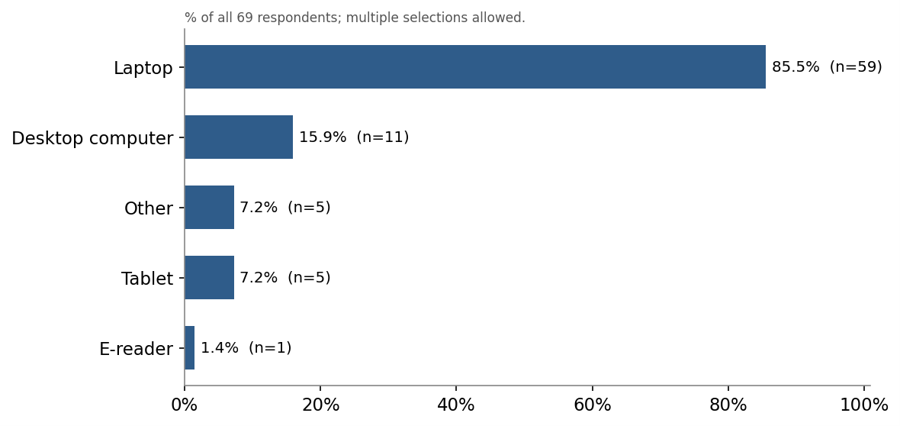
Awareness of AI writing and study tools was almost universal, with 62 respondents indicating that they were aware of tools such as ChatGPT, QuillBot and Gemini. As shown in Figure 1, the laptop was by far the most common device used to access learning, reported by 85.5 percent of respondents (59 of 69), followed by the desktop computer at 15.9 percent (11), the tablet at 7.2 percent (5) and the e-reader at 1.4 percent (1). The dominance of personal laptops, alongside the limited use of institutional desktop facilities, frames the access conditions for the findings that follow.
Figure 1
Devices used to access learning (multiple response). Source: survey data (N = 69)
3.3. AI Tools Used for Academic Work
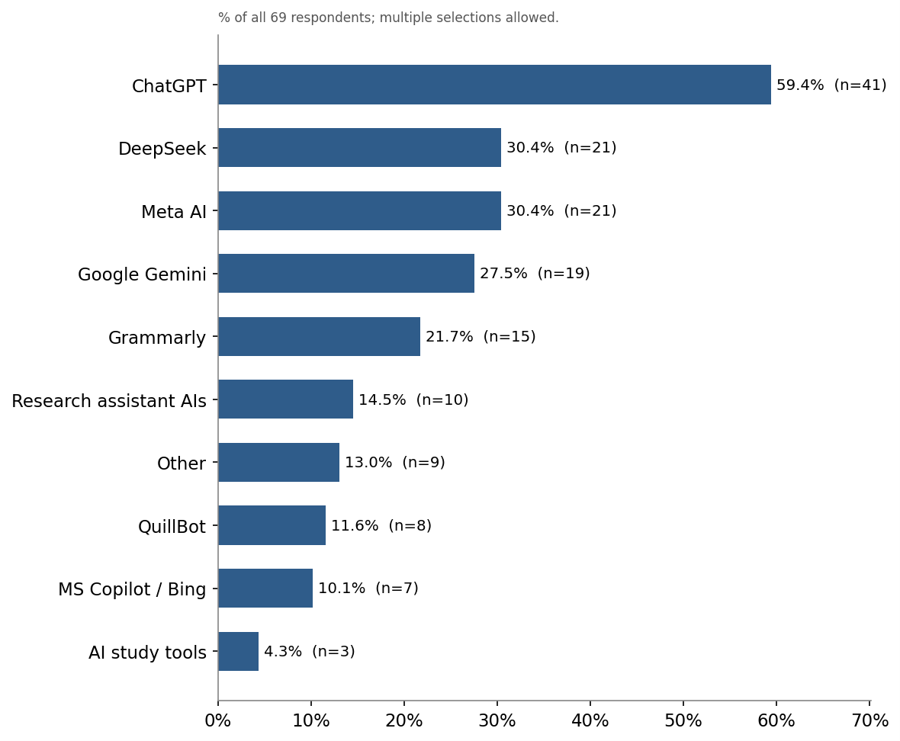
Respondents drew on a range of tools, as presented in Figure 2. ChatGPT was the most widely used, reported by 59.4 percent of respondents (41 of 69). DeepSeek and Meta AI followed, each used by 30.4 percent (21), and Google Gemini by 27.5 percent (19). Grammarly was used by 21.7 percent (15), dedicated research-assistant tools by 14.5 percent (10), and QuillBot, Microsoft Copilot and AI study tools by smaller shares. General-purpose conversational tools, led by ChatGPT, rather than specialised academic tools, dominate everyday academic use. One student interviewed (S1) highlighted that:
I normally use ChatGPT in writing my assignments as well as writing my thesis. It has proved to be useful in simplifying complex topics.
Another student interviewed (S2) highlighted that:
I rely on AI in reviewing my assignments and improving language, removing repetition, smoothing the transitions between paragraphs and sections, and ensuring consistent terminology and style throughout.
Figure 2
AI tools used for academic work (multiple response). Source: survey data (N = 69)
3.4. Frequency and Purpose of Use
Use was frequent but not uniformly intensive. As Figure 3 shows, the most common pattern was using AI a few times a week (46.0 percent of valid responses), followed by daily use (23.8 percent), rare use (15.9 percent), weekly use (7.9 percent) and a few times a month (6.3 percent). When asked for the single most important reason for using AI, a clear majority pointed to comprehension rather than shortcut-taking. This was further supported by one interviewee (S3) who pointed out that:
I rely on AI in mostly during my continuous assessment which can be administered on periodic bases and daily in reading after lectures. However, during my work related, I only focused in gaining practical skills.
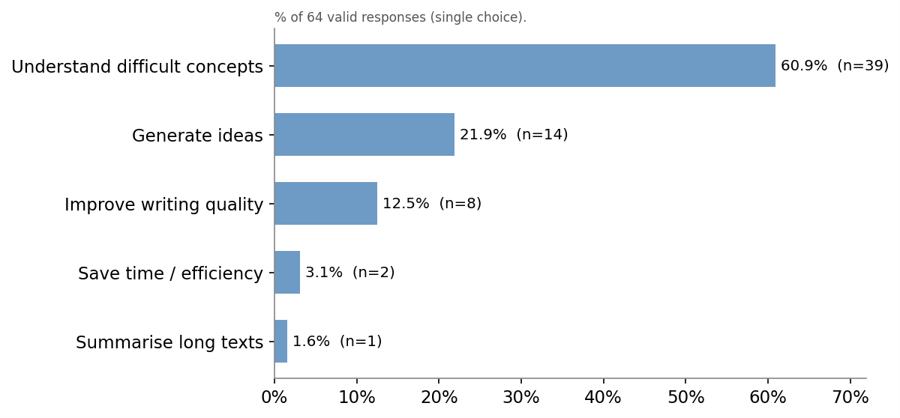
As shown in Figure 4, 60.9 percent of valid respondents used AI primarily to get help understanding difficult concepts, 21.9 percent to generate ideas for assignments, and 12.5 percent to improve the quality of their writing, with only small shares citing time-saving or summarising.
Figure 3
Frequency of AI use for academic work. Source: survey data (N = 69)
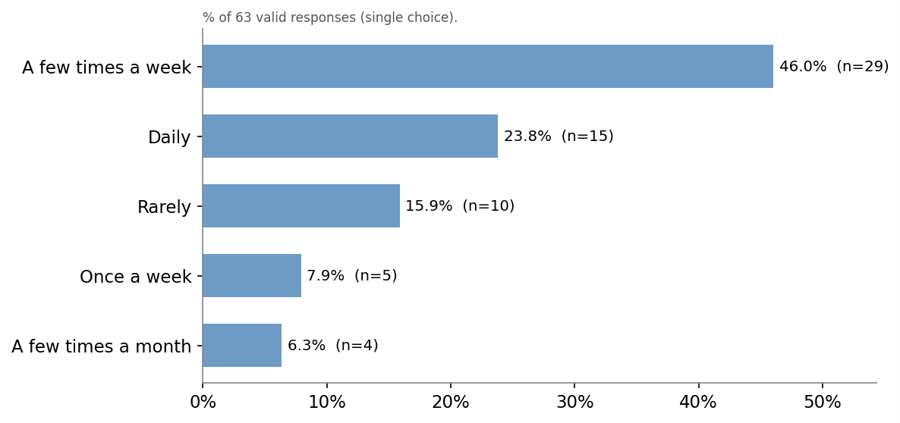
Figure 4
Primary reason for using AI. Source: survey data (N = 69)
3.5. Perceived Effect on Academic Development
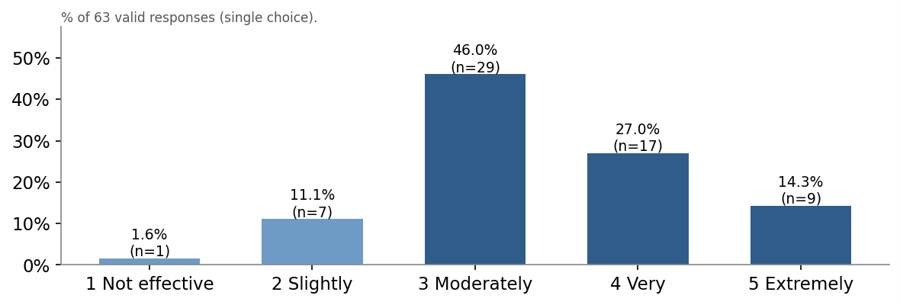
Respondents rated, on a scale of one to five, how effective AI had been for their academic development. As Figure 5 indicates, ratings clustered in the upper-middle of the scale: 46.0 percent rated AI moderately effective, 27.0 percent very effective and 14.3 percent extremely effective, while 11.1 percent considered it only slightly effective and a single respondent rated it not effective. A clear majority regarded AI as at least moderately effective, though outright top-box endorsement was the exception.
Figure 5
Perceived effectiveness of AI for academic development (1 to 5 scale). Source: survey data (N = 69)
3.6. Perceived Benefits
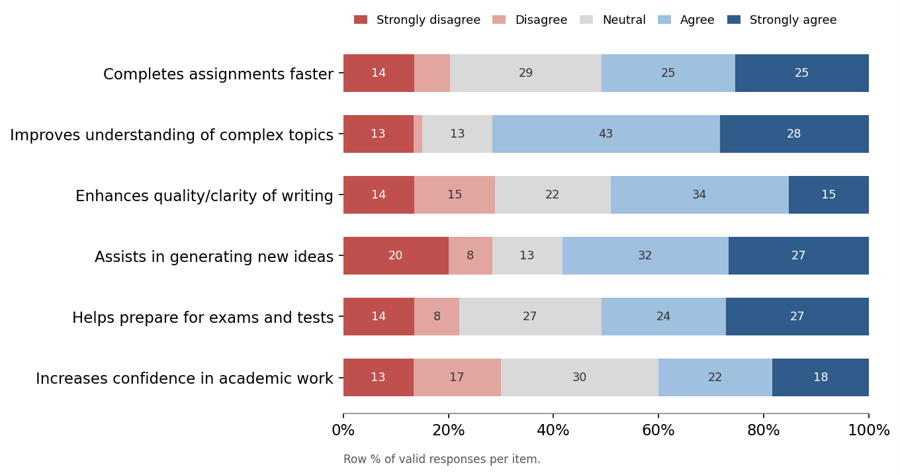
Agreement with the stated benefits of AI was generally positive but qualified, as set out in Figure 6. Respondents most often agreed that AI improves their understanding of complex topics and assists in generating new ideas, while agreement was more divided on whether AI enhances the quality of their writing and whether it increases their confidence in academic work. The in-depth interviews confirmed that AI improved students’ understanding of complex topics. One student (S4) indicated that:
Through the use of AI, my understanding of complex topics has been simplified. I have relied on ChatGPT to simplify complex topics, and this has improved my continuous assessment for the past semester.
A meaningful minority disagreed with several benefit statements, indicating that positive perceptions, while prevalent, were not unanimous.
Figure 6
Perceived benefits of AI (level of agreement). Source: survey data (N = 69)
3.7. Perceived Risks, Costs and Concerns
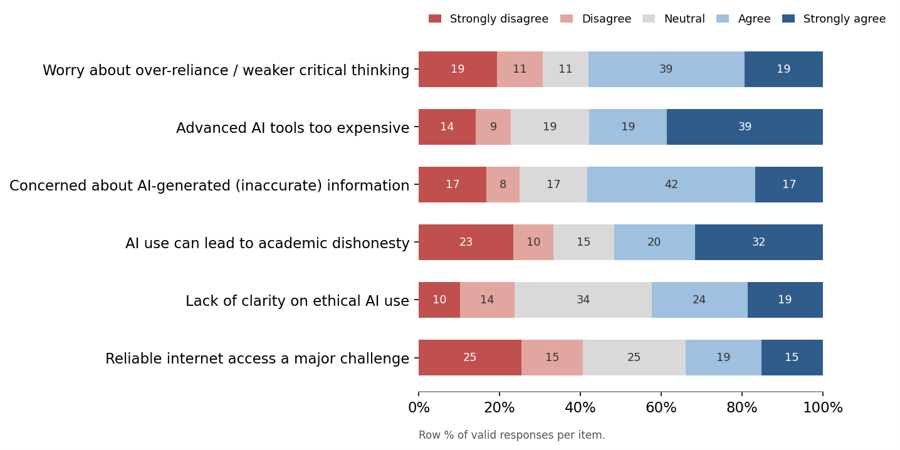
Respondents also expressed substantial reservations, presented in Figure 7. Concern about the accuracy of AI-generated information attracted the highest agreement, with 58.3 percent agreeing or strongly agreeing, closely followed by worry about over-reliance weakening critical-thinking skills at 58.1 percent and the view that advanced AI tools are too expensive at 57.9 percent. Just over half (51.7 percent) agreed that AI use can lead to academic dishonesty. Agreement was lower, and neutrality higher, on whether there is a lack of clarity about the ethical use of AI (42.4 percent) and on whether reliable internet access is a major challenge (33.9 percent). Cost, accuracy and over-reliance, rather than connectivity alone, were the most strongly felt concerns. This was also confirmed by the observation carried out by the researchers, where students were observed using their smartphones to consult AI while writing in-class tests as part of continuous assessment.
Figure 7
Perceived risks and concerns about AI (level of agreement). Source: survey data (N = 69)
3.8. Negative Consequences Experienced
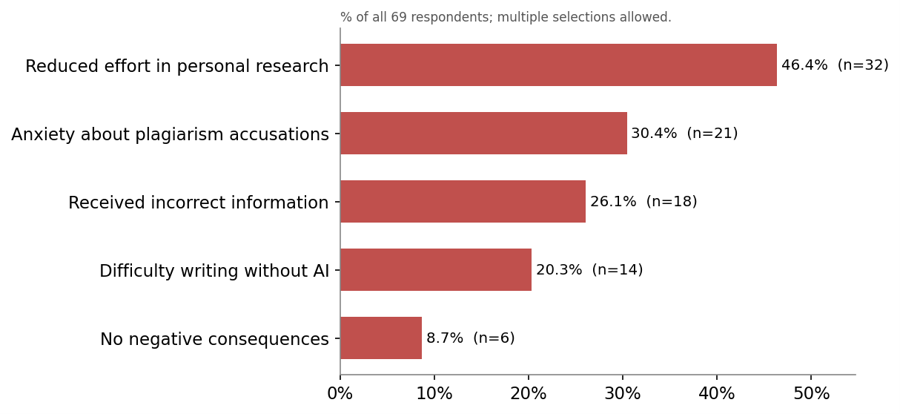
Finally, respondents indicated which negative consequences, if any, they had personally experienced; results are shown in Figure 8. The most commonly reported was reduced effort in personal research, cited by 46.4 percent of respondents (32 of 69), followed by anxiety about being accused of plagiarism at 30.4 percent (21) and receiving incorrect information from an AI tool at 26.1 percent (18). Difficulty writing without AI assistance was reported by 20.3 percent (14), while only 8.7 percent (6) reported experiencing no negative consequences. The prominence of reduced research effort, together with reported plagiarism-related anxiety, points to genuine concerns about academic skill and integrity even among a group that broadly valued AI. From the in-depth interviews (S5), one student indicated that:
I have been trying to reduce my plagiarism index below the threshold of 20% set by the university in the AI policy, but I have failed, and I fear repeating the dissertation.
Figure 8
Negative consequences experienced (multiple response). Source: survey data (N = 69)
4. Discussion
4.1. Interpretive Note on Scope
These findings describe AI use and its perceived effects on academic development within a small, senior, mostly female sample at a single institution, using a cross-sectional design. The instrument did not include a validated measure of psychological wellbeing. The data therefore support descriptive statements about how students use AI and how they perceive its benefits and risks, but they do not support inferential claims of a significant association between AI use and mental-health outcomes such as stress or anxiety. The single plagiarism-related anxiety item above is a perception of a specific academic risk and should not be read as a measure of clinical anxiety.
4.2. Comparison with Gawe and Gudyanga (2025)
Read against Gawe and Gudyanga (2025), the findings show that the two studies are not directly comparable because they differ in design, sample and questions addressed. Their study interviews produced overwhelmingly positive perceptions (14 of 15 students). In this survey, 87.3 percent rated AI at least moderately effective for their academic development, although agreement with individual benefit statements was more qualified and a meaningful minority disagreed. Both studies identify ChatGPT as the leading tool, yet it is reported by 90 percent of participants in the earlier study’s figure and by 59.4 percent here, where respondents could select from a wider list that included DeepSeek, Meta AI and Gemini. Differences in sample size, tool list and timing of data collection may account for the gap, and it should not be read as a decline in use.
Concern about over-reliance is the clearest point of agreement. Twelve of 15 students in the earlier study worried that AI was impairing critical thinking and human interaction, and 58.1 percent of respondents here agreed that over-reliance weakens critical-thinking skills. The present data add two points. The most commonly reported personal consequence was reduced effort in personal research (46.4 percent), and cost (57.9 percent) was endorsed more often than unreliable internet access (33.9 percent) as a constraint. The earlier study discussed infrastructural limitations and digital divides in general terms; the survey suggests that, among students who mostly access learning on laptops (85.5 percent), the price of advanced tools may matter more than connectivity alone.
The studies also differ in emphasis. Gawe and Gudyanga report accessibility benefits that this survey did not examine, such as text-to-speech support for a student with dyslexia. This study, in turn, quantifies integrity-related concerns that the earlier study raised mainly through participant accounts (51.7 percent agreed that AI can lead to academic dishonesty, and 30.4 percent reported anxiety about being accused of plagiarism). Taken together, the two studies suggest that AI is widely used and valued at this university and that concern about dependence appears across methods and cohorts. Because both rely on a single campus and non-random samples, neither supports generalisation to Zimbabwean higher education as a whole.
5. Conclusion and Recommendations
The use of AI among students in the Department of Development Studies is motivated by a strong, logical desire for improved comprehension and academic efficiency. The main driving force is the perceived efficiency of AI as a means of overcoming obstacles in the classroom and enhancing results. Demographically, the population is dominated by the 23-27 age group (69%) and is predominantly female (63.1% of those who reported sex). Technologically, usage is overwhelmingly centred on the laptop (85.5%) and, in terms of AI tools, is led by ChatGPT (59.4%). Usage is frequent, concentrated in the top two frequency categories, and attitudes are mostly favourable, where the combined Agree and Strongly Agree responses often constitute the majority, though Neutral remains a large segment in several five-point scales. In order to manage the serious plagiarism-related integrity concerns, Midlands State University should consider clarifying and strengthening its AI governance policies. By guaranteeing fair access and changing AI from an uncontrolled, potentially skill-degrading instrument into a structured, widely available academic partner, universities could help to address the 57.9% of students who consider advanced AI tools too expensive. Relative to earlier qualitative work, the study’s contribution is to quantify these patterns and to show that concerns about dependence, cost and academic integrity persist across methods, while recognising that both studies are confined to a single campus.
AI Disclosure Statement
The authors have not used any AI tools in writing this paper.
Ethical Approval
This study received ethical clearance from the Research Ethics Committee, Faculty of Arts and Humanities, Midlands State University, Zimbabwe (Reference No. 8v; clearance letter dated 9 December 2025). The Committee reviewed the study’s methodology and interview guide and confirmed that they met the requirements of the Faculty of Arts and Humanities Ethics Guidelines before authorising the researcher to proceed with data collection and to submit the findings for publication.
Informed Consent
Verbal (oral) informed consent was obtained from all participants in the in-depth interviews and focus group discussions, consistent with the oral, interview-based data-collection design specified in the ethics clearance. Verbal consent was chosen over written consent because it was consistent with this oral methodology and allowed consent to be obtained as a natural part of the interview and discussion process. The ethics clearance approved the study’s overall methodology and interview guide, including the use of oral interviews. Verbal consent was recorded by the researcher in the interview and focus-group-discussion field notes at the start of each session and retained together with the study’s field records. For the cross-sectional student survey, informed consent was obtained electronically: respondents were presented with a consent statement at the start of the KoboToolbox questionnaire and were required to indicate their agreement before proceeding to the survey questions.
Data Availability
The data that support the findings of this study are available from the corresponding author, Cephas Mandirahwe (mandirahwec@staff.msu.ac.zw), upon reasonable request.
References
Baker, T., Smith, L., & Anissa, N. (2019). Educ-AI-tion rebooted? Exploring the future of artificial intelligence in schools and colleges. Nesta. https://media.nesta.org.uk/documents/Future_of_AI_and_education_v5_WEB.pdf
Chen, J., Yuan, D., Dong, R., Cai, J., Ai, Z., & Zhou, S. (2024). Artificial intelligence significantly facilitates development in the mental health of college students: A bibliometric analysis. Frontiers in Psychology, 15, Article 1375294. https://doi.org/10.3389/fpsyg.2024.1375294
Chen, X., Xie, H., & Hwang, G. J. (2020). A multi-perspective study on artificial intelligence in education: Grants, conferences, journals, software tools, institutions, and researchers. Computers and Education: Artificial Intelligence, 1, 100005. https://doi.org/10.1016/j.caeai.2020.100005
Crawford, J., Allen, K. A., Pani, B., & Cowling, M. (2024). When artificial intelligence substitutes humans in higher education: The cost of loneliness, student success, and retention. Studies in Higher Education, 49(5), 883–897. https://doi.org/10.1080/03075079.2024.2326956
Creswell, J. W., & Plano Clark, V. L. (2007). Designing and conducting mixed methods research. Sage Publications.
Dey, N. C. (2024). Mental health of adolescents and youth in India: A critical analysis in the era of AI [Preprint]. SSRN. https://doi.org/10.2139/ssrn.5056368
Easterby-Smith, M., Thorpe, R., & Lowe, A. (1991). Management research: An introduction. Sage Publications.
Facione, P. A. (2020). Critical thinking: What it is and why it counts. Insight Assessment. https://insightassessment.com/wp-content/uploads/2023/12/Critical-Thinking-What-It-Is-and-Why-It-Counts.pdf
Gawe, A., & Gudyanga, A. (2025). The impact of artificial intelligence (AI) on development studies’ learners at one State university campus in Zvishavane, Zimbabwe. Cogent Education, 12(1), Article 2539217. https://doi.org/10.1080/2331186X.2025.2539217
Gu, Y., & Zhou, K. (2023). Paths to strengthen mental health education for college students in the era of artificial intelligence. International Journal of New Developments in Education, 5(26). https://doi.org/10.25236/ijnde.2023.052612
Holmes, W., Bialik, M., & Fadel, C. (2019). Artificial intelligence in education: Promises and implications for teaching and learning. Center for Curriculum Redesign.
Holmes, W., & Tuomi, I. (2022). State of the art and practice in AI in education. European Journal of Education, 57(4), 542–570. https://doi.org/10.1111/ejed.12533
Huber, G. P., & Power, D. J. (1985). Retrospective reports of strategic-level managers: Guidelines for increasing their accuracy. Strategic Management Journal, 6(2), 171–180. https://doi.org/10.1002/smj.4250060206
Hwang, G. J., Xie, H., Wah, B. W., & Gasevic, D. (2020). Vision, challenges, roles and research issues of artificial intelligence in education. Computers and Education: Artificial Intelligence, 1, 100001. https://doi.org/10.1016/j.caeai.2020.100001
Luckin, R., Holmes, W., Griffiths, M., & Forcier, L. B. (2016). Intelligence unleashed: An argument for AI in education. Pearson Education.
Pinkwart, N. (2016). Another 25 years of AIED? Challenges and opportunities for intelligent educational technologies of the future. International Journal of Artificial Intelligence in Education, 26(2), 771–783. https://doi.org/10.1007/s40593-016-0099-7
Qadir, J. (2023). Engineering education in the era of ChatGPT: Promise and pitfalls of generative AI for education. In 2023 IEEE Global Engineering Education Conference (EDUCON) (pp. 1–9). IEEE. https://doi.org/10.1109/EDUCON54358.2023.10125121
Selwyn, N. (2022). Education and technology: Key issues and debates (3rd ed.). Bloomsbury Academic.
Vieriu, A. M., & Petrea, G. (2025). The impact of artificial intelligence (AI) on students’ academic development. Education Sciences, 15(3), Article 343. https://doi.org/10.3390/educsci15030343
Williamson, B. (2017). Big data in education: The digital future of learning, policy and practice. Sage Publications.
Zawacki-Richter, O., Marín, V. I., Bond, M., & Gouverneur, F. (2019). Systematic review of research on artificial intelligence applications in higher education—Where are the educators? International Journal of Educational Technology in Higher Education, 16(1), Article 39. https://doi.org/10.1186/s41239-019-0171-0
Appendix: Survey Questionnaire (KoboToolbox)
https://pedagogie-digitala.ro/articol/anexe/2026_Mandirahwe_Sisimayi_appendix_01.pdf
Authors
Cephas Mandirahwe
Department of Development Studies, Midlands State University, Zimbabwe
mandirahwec@staff.msu.ac.zw – corresponding author
 https://orcid.org/0000-0002-9534-3369
Tapiwa Patson Sisimayi
ETHMUTAR Consultancy (Pvt) Ltd, Zimbabwe
https://orcid.org/0000-0003-3690-4733
Authors’ Biographies
Cephas Mandirahwe is a lecturer at Midlands State University, Department of Development Studies. His research interests include Artificial Intelligence in academic development and Education for Sustainable Development.
Tapiwa Patson Sisimayi is a Senior Monitoring, Evaluation, Accountability and Learning (MEAL) Specialist, Data Analytics Expert and academic with over ten years of experience in development programming, research and evaluation. He has worked across government, academia and the development sector, providing technical expertise in results-based management, programme evaluation, data analytics and institutional learning.
Received: 12.09.2026. Accepted and published: 5.11.2026
© Cephas Mandirahwe & Tapiwa Patson Sisimayi, 2026. Published by the Institute for Education (Bucharest). This open access article is distributed under the terms of the Creative Commons Attribution Licence CC BY, which permits unrestricted use, distribution, and reproduction in any medium, provided the original author and source are credited:
Citation:
Mandirahwe, C. & Sisimayi, T. P. (2026). Artificial Intelligence and Student Academic Development: Use, Perceptions and Concerns Among Final Year Students in the Department of Development Studies, Midlands State University, Zimbabwe. Revista de Pedagogie Digitala, 5(1) 50-60. Bucharest: Institute for Education. https://doi.org/10.61071/RPD.2693
Accesări: 74