
Generation Z students bring digital fluency, shortened attention rhythms, and a preference for experiential learning into classrooms still shaped by pre-digital pedagogy. This mixed-methods study examines how 100 Romanian secondary-school teachers perceive and respond to the generational characteristics of their students, complemented by focus-group interviews with 10 middle- and high-school students. Results reveal a pronounced awareness–practice gap: while 85% of teachers report familiarity with Generation Z traits and 88% acknowledge the need for pedagogical adaptation, only 44% successfully diversify their methods to the point where difficulties diminish. Students, in turn, describe teaching as insufficiently responsive to their learning preferences. The study identifies attention maintenance, student disengagement, and disciplinary tensions as the dominant challenges, and shows that teachers who employ blended, interactive, and technology-enhanced strategies report significantly fewer classroom difficulties. These findings carry practical implications for teacher professional development in digitally evolving educational contexts.
Keywords: Generation Z, teacher-student relationship, digital natives, digital pedagogy, pedagogical adaptation
____________________
Revista de Pedagogie Digitala – ISSN 3008-2013
2026, Vol. 5, Nr. 1, pp. 33-40
https://doi.org/10.61071/RPD.2635
HTML | PDF
____________________
Introduction
Every generation of teachers eventually confronts a cohort of learners whose formative experiences diverge sharply from their own. What makes the current encounter distinctive is the depth of the technological divide. Generation Z – broadly defined as those born between 1997 and 2012 (Twenge, 2017) – is the first cohort to have no memory of a world without smartphones, social media, and on-demand information. Their cognitive habits, communication styles, and learning preferences have been shaped by constant connectivity, a reality that most of their teachers experienced only in adulthood. As Bonchiş (2021) observes, each generation is individualised by a distinct combination of biological, psychological, and sociocultural factors – and for Gen Z, the sociocultural factor that overwhelms all others is the digital environment.
The pedagogical consequences are not trivial. Research consistently shows that Gen Z learners favour short-form, visually rich content, prefer collaborative and experiential tasks over passive lectures, and expect technology integration as a baseline rather than a bonus (Seemiller & Grace, 2016; Schwieger & Ladwig, 2018). A systematic review of 121 studies confirmed that traditional instructional methods frequently fail to capture Gen Z attention, with students who engage in habitual digital multitasking showing a 40% higher rate of attentional difficulties compared to focused peers (Ophir et al., 2009, cited in Khalil & Faas, 2025). Meanwhile, the teachers charged with reaching these learners – predominantly members of Generation X (born 1964–1980) and Generation Y (born 1981–1996) – were trained within paradigms that predate the smartphone era.
Romania presents a particularly instructive case. The country’s education system ranks below the EU average in digital skills: according to the European Commission’s Digital Decade Report (2024), less than 28% of Romanians aged 16–74 possess basic digital competences, compared to the EU average of 55.6%. The digitalisation national strategies explicitly targeted this gap, yet implementation remains uneven across regions, and teacher digital competence varies significantly between urban and rural settings (OECD, 2024). Against this backdrop, the present study asks a straightforward question: how do Romanian teachers perceive, confront, and adapt to the generational characteristics of their Gen Z students – and do these adaptations translate into classroom reality?
1. Theoretical Background
Understanding why the current teacher–student dynamic differs from previous generational transitions requires three intersecting lenses. The first concerns the learners themselves: what does it mean, cognitively and behaviourally, to have grown up immersed in digital technology? The second concerns the relationship: how does generational misalignment erode the trust, reciprocity, and engagement that effective teaching depends on? The third concerns the response: what does the evidence say about pedagogical strategies that actually work with this population?
These three dimensions – learner profile, relational strain, and adaptive practice – structure the literature reviewed below. Together, they frame the empirical investigation that follows: not as a study of technology per se, but as an inquiry into whether teachers’ understanding of a generationally distinct student body translates into measurably different classroom practice.
1.1. Generation Z as Digital Natives
Marc Prensky’s (2001) metaphor of “digital natives” and “digital immigrants” remains the most widely cited frame for understanding the technology gap in classrooms, despite legitimate critiques of its binary simplicity (Akçayır et al., 2016). The core claim – that early, immersive exposure to technology reshapes cognitive processing – has found partial support in neuroscience. Repeated digital interaction appears to strengthen parallel processing and rapid information filtering while weakening sustained, linear attention (Prensky, 2001; Wilmer et al., 2017). Digital natives are, in Aljović’s (2024) phrasing, natural speakers of the digital language – fluent in the idiom of computers, video games, and the internet. Elmore (2023) reports that by 2020, over 90% of children under three were using tablets or mobile devices, with 75% owning their own device by age two. A study by Buzzetto-Hollywood and Quinn (2024) confirmed that Gen Z students, having used tablets before they could ride bicycles, display a 30% shorter attention span than Millennials in structured academic tasks.
Yet the “native” label deserves nuance. As Sa’diyah and Prasetiyo (2023) argue in a systematic review, digital nativeness is not innate but developmental; significant variations in digital proficiency exist within the generation, shaped by socioeconomic access and educational quality. This is especially relevant in Romania, where 60% of respondents in a 2020 European Commission survey reported having never used online learning tools before the pandemic.
1.2. The Teacher–Student Relationship Under Pressure
Jowett et al. (2023) conceptualised the teacher–student relationship as a barometer of teaching effectiveness, comprising mutual trust, respect, and reciprocal engagement. When generational characteristics create misalignment – as when a teacher trained in linear exposition meets a learner wired for hypertext navigation – this relational quality erodes. Dejacto et al. (2023) documented that teachers in the Philippines identified difficult student behaviour as their primary challenge when working with Gen Z learners, followed by negative technology effects and declining academic performance.
These patterns appear cross-cultural. Shirazian et al. (2025) observed that medical faculty report spending more time managing distraction than delivering content; López et al. (2023) found that Gen Z students are perceived as impatient, assertive, and oriented toward immediate gratification. Gordon’s model of effective teacher–student relationships – built on transparency, mutual care, and interdependence (Gordon & Burch, 2011) – provides a normative baseline, but achieving these qualities requires pedagogical flexibility that many educators have not been trained to exercise.
1.3. Bridging the Gap: Pedagogical Adaptation
Recent literature converges on several strategies. Active learning approaches – flipped classrooms, gamification, project-based learning, and blended instruction – consistently outperform traditional lecturing in Gen Z engagement metrics (Khalil & Faas, 2025; Gochenouer et al., 2025). A Frontiers in Education systematic review identified that effective teacher professional development (TPD) programs share four characteristics: collaborative learning environments, hands-on digital training, ongoing mentorship, and institutional support (Adeniran & Alozie, 2025). Critically, Quinio et al. (2024) found that generational classification per se does not predict technology integration – what matters is sustained professional development and institutional culture.
2. Methodology
The awareness–practice gap hypothesised in the theoretical framework requires evidence from both sides of the classroom. Teachers’ self-reported perceptions alone risk inflating the extent of adaptation; student accounts alone lack the systemic view that comes from surveying a larger professional sample. This study therefore employed a mixed-methods design combining a questionnaire administered to 100 teachers with focus-group interviews involving 10 students, producing two complementary datasets that could be examined for convergence and divergence. Data were collected during the 2023–2024 academic year in Romania.
Participants. The questionnaire was administered online (Google Forms) to 100 teachers working in middle-school (gymnasium) and high-school settings, recruited through voluntary sampling. Two focus groups, each comprising five students (one middle-school, one high-school group), were conducted via Zoom.
Instruments. The teacher questionnaire included 31 items (8 demographic, 23 substantive), combining open, closed, and semi-closed formats. The focus-group guide contained 10 questions exploring student perceptions of teacher behaviour, learning preferences, and the role of technology.
Analysis. Content analysis was applied to both datasets: responses were coded, grouped into thematic categories, and examined for frequency distributions and convergent/divergent patterns across teacher and student perspectives.
Limitations. The sample skews female and middle-aged, consistent with Romania’s teaching demographics but limiting generalizability. Several teachers conflated relational and instructional challenges in open-ended responses, suggesting the instrument could benefit from sharper item differentiation in future iterations
3. Results
The data paint a picture that is simultaneously encouraging and cautionary. Romanian teachers are not oblivious to Generation Z – far from it. They read about it, discuss it in staff rooms, and most claim to have adjusted their practice accordingly. Yet when the numbers are disaggregated and student voices are placed alongside teacher self-reports, a gap opens between what educators believe they are doing and what learners actually experience.
The results are presented in four stages: the demographic and generational profile of the teacher sample; the discrepancy between declared awareness and reported difficulties; the methodological signature of teachers who navigate Gen Z classrooms without friction; and, finally, the students’ own account of what reaches them and what does not. This sequence moves from context to contradiction to explanation, mirroring the analytical logic that emerged from the data themselves.
3.1. Teacher Profile and Generational Composition
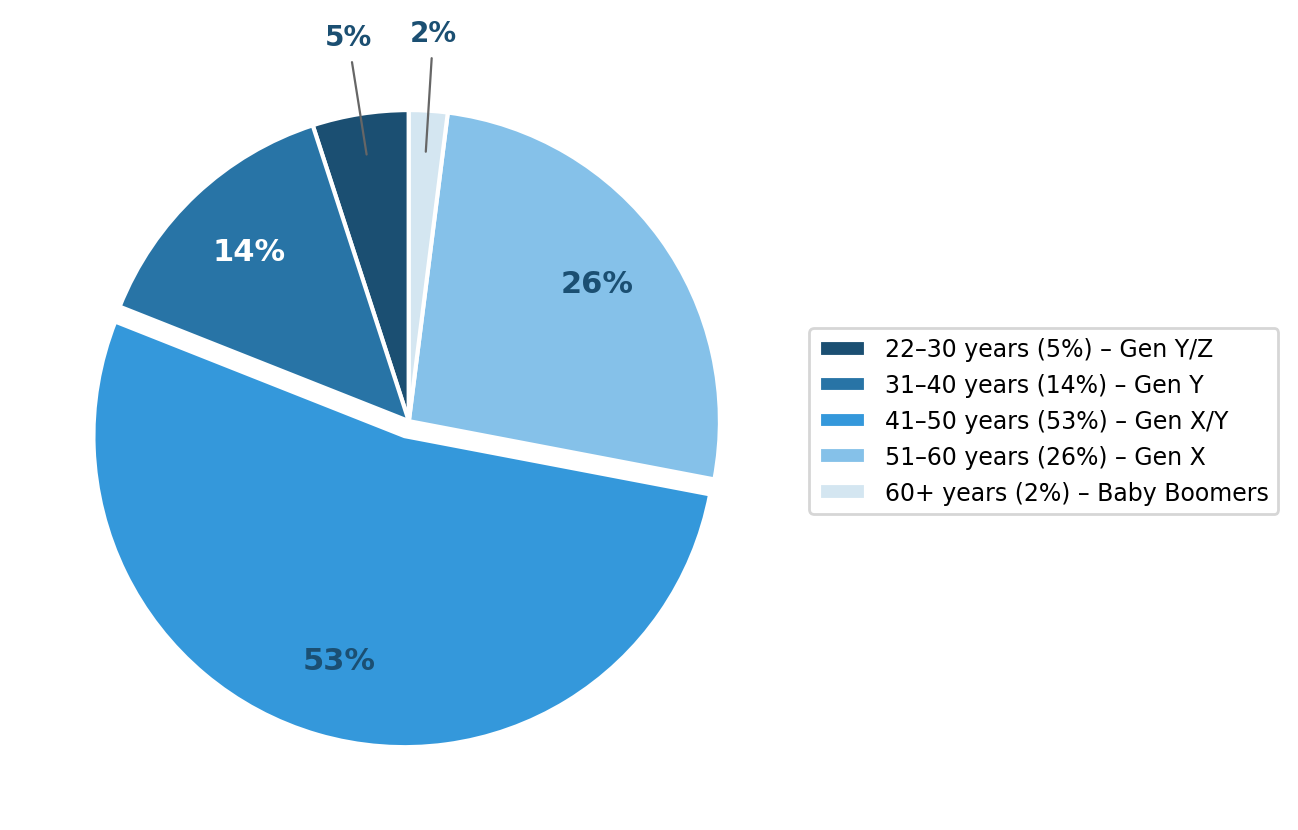
The sample’s age distribution reveals a workforce predominantly belonging to Generations X and Y (Figure 1). Over half the respondents (53%) were aged 41–50, placing them in the Gen X/Y overlap; another 26% were aged 51–60 (Gen X). Only 5% were under 30. This means the vast majority of teachers in the sample experienced their own schooling and professional training in entirely pre-smartphone, pre-social-media contexts – a generational distance of roughly 25–35 years from their students
Figure 1
Age Distribution of Surveyed Teachers (N = 100)
3.2. Awareness Versus Practice
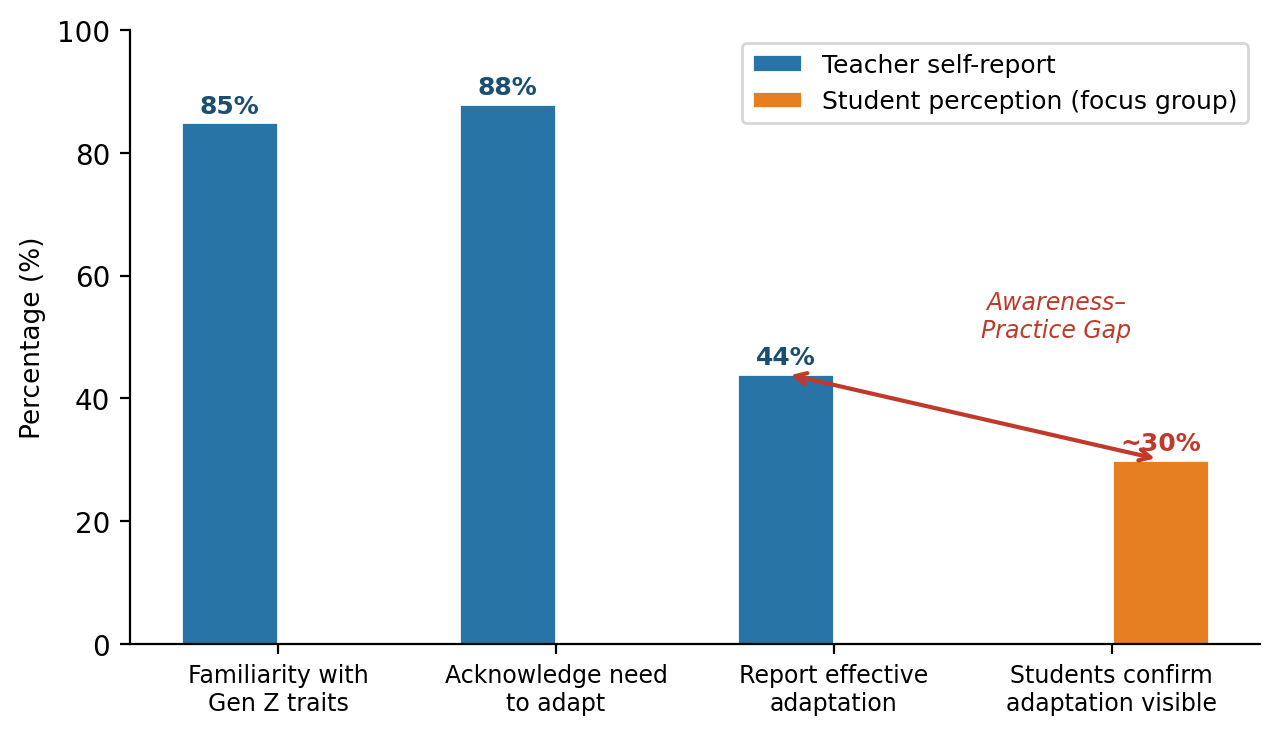
Eighty-five percent of teachers reported being familiar with the defining characteristics of Generation Z, and 88% stated that they consciously adapt their classroom strategies. At first glance, these figures suggest a well-prepared workforce. However, the data tell a more complex story when cross-referenced with actual teaching difficulties and student feedback.
Teachers were split almost evenly on whether they experience difficulties: 56% reported challenges in their work with current students, while 44% did not. Content analysis of the open-ended responses from the 56% who reported difficulties produced five thematic clusters (Figure 2).
Figure 2
Categories of Difficulties Reported by Teachers (n = 56 who reported challenges)
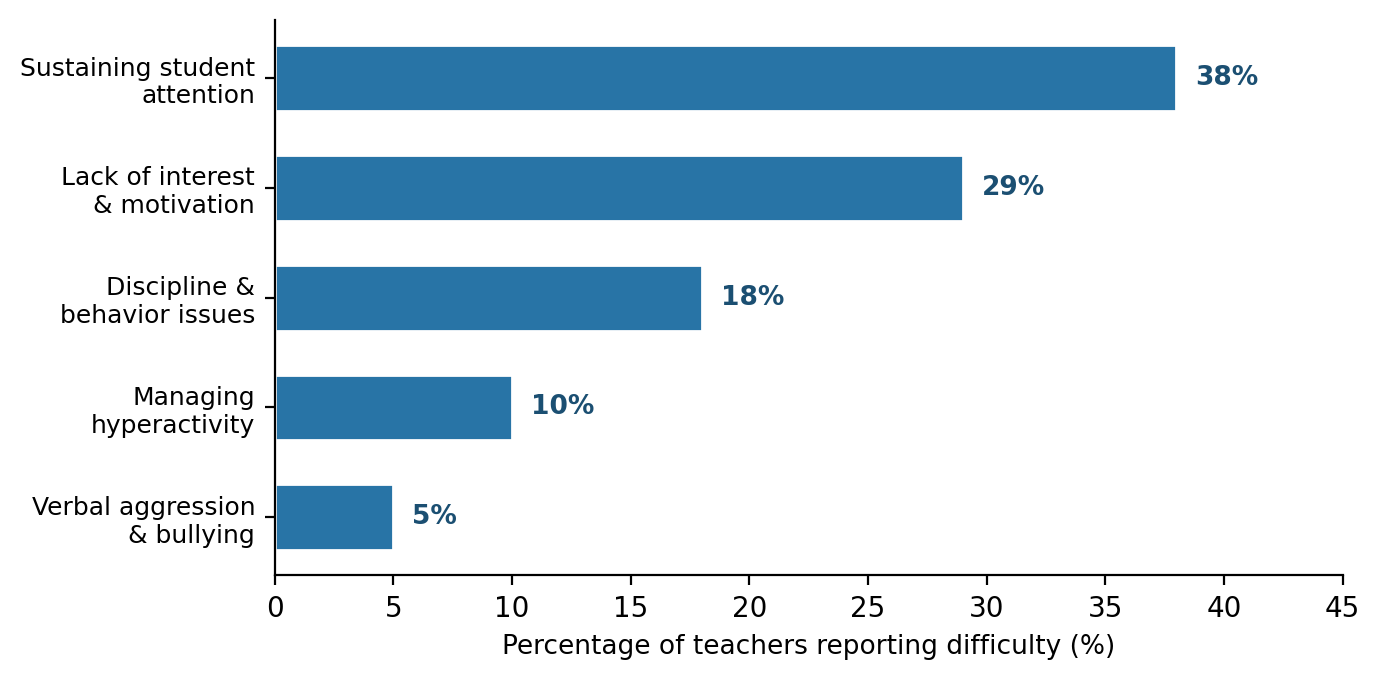
Sustaining attention dominated the complaints. Teachers described students who “cannot focus for more than 10–15 minutes,” consistent with research placing Gen Z’s screen-based attention span at approximately 47 seconds before task-switching (Mark, 2023). Disengagement and motivational deficit formed the second cluster, with teachers noting that students “learn only for grades, not for understanding.” Disciplinary problems – including verbal aggression and frequent bullying – comprised the third.
3.3. The 44% Who Reported No Difficulties
The contrast group offers the study’s most actionable finding. Teachers who reported no significant difficulties described a diverse, technology-integrated methodological repertoire: brainstorming, jigsaw, flipped classroom, concept mapping, role-play, learning apps, and blended learning combinations. Representative responses included: “A mix of methods, depending on the class and their mood”; “Modern methods interwoven with traditional ones”; “PowerPoint with images, interactive games, LearningApps, online quizzes.”
This pattern suggests that methodological diversification – not mere awareness of Gen Z traits – is the operative variable in managing classroom dynamics. Awareness without operational change produces the gap illustrated in Figure 3.
Figure 3
The Awareness–Practice Gap: Teacher Self-Report vs. Student Perception
3.4. Student Perspectives
Focus-group data introduced a corrective to the teachers’ self-assessment. Students described a classroom reality where adaptation is less visible than teachers believe. Their responses clustered around three themes (Table 1).
Table 1
Thematic Clusters from Student Focus Groups (N = 10)
| Theme | Student voices (illustrative) | Interpretation |
| Unrecognised learning preferences | “Most teachers are not aware; I would prefer lessons with more practice.” (Student 7) | Students feel their preference for experiential, hands-on tasks is overlooked. |
| Demand for technology integration | “Our preferences should be taken seriously. Technology should be applied much more at school.” (Student 2) | Technology is perceived as a necessity, not a luxury – part of their cognitive environment. |
| Need for differentiated instruction | “Teachers should consider that not all children can memorise things or solve certain exercises.” (Student 2) | Students articulate a need for instructional flexibility that mirrors universal design for learning principles. |
4. Discussion
The central finding of this study – a gap between declarative awareness and operational adaptation – resonates with wider research. Quinio et al. (2024) found that generational classification does not predict technology integration in teaching; what matters is sustained professional development. Similarly, Adeniran and Alozie (2025) showed that one-time training sessions yield negligible long-term impact, while collaborative, mentorship-based TPD programs produce lasting change. Our data support this distinction: the 44% of teachers who reported no difficulties were not younger or more “digitally native” themselves – they were methodologically flexible.
The attention deficit reported by 38% of struggling teachers aligns with a growing body of evidence. Gloria Mark’s longitudinal research documents a decline in screen-based attention from over two minutes in 2004 to 47 seconds in 2024, a trend amplified in classroom settings (Mark, 2023). The implication is structural, not motivational: Gen Z students are not choosing to disengage – their attentional architecture has been shaped by environments that reward rapid switching. Prensky (2001) made this argument early; two decades of evidence have largely confirmed it. Pedagogies designed for sustained, linear attention will systematically underserve this population.
Student focus-group data add a dimension often missing from teacher-centric research. The demand for technology, practice, and differentiation is not a whim – it reflects a cognitive environment in which information has always been on-demand, visual, and interactive. Khalil and Faas (2025) identified project-based learning and formative assessment as the two approaches that most reliably enhance Gen Z engagement and autonomy, findings consistent with our observation that teachers using blended and interactive methods report fewer difficulties.
Romania’s particular context intensifies these dynamics. The Digital Pedagogy programme aspires to 50% digital literacy, yet the 2024 EU data show Romania at 28%. Teacher training programmes have only recently begun to include digital pedagogy modules (Istrate, Velea, & Ceobanu, 2025), and access to infrastructure remains unequal. The gap this study identifies is therefore not only generational but also systemic: teachers lack not just willingness, but institutional support, equipment, and structured professional development.
Conclusions and Implications
This study set out to identify the challenges and adaptive strategies of Romanian teachers working with Generation Z students. Three conclusions emerge.
First, awareness alone is insufficient. The majority of teachers recognise Gen Z’s characteristics, but recognition without methodological diversification does not reduce classroom difficulties. The 44% of teachers who reported smooth classroom interactions were distinguished not by age or generational proximity to students, but by a varied, technology-informed pedagogical repertoire.
Second, the teacher–student relationship in Gen Z classrooms is shaped by a structural mismatch between how students process information and how instruction is designed. This is not a disciplinary problem amenable to stricter rules; it is a design problem requiring redesigned learning experiences.
Third, the Romanian context underscores the importance of systemic investment. Individual teacher effort cannot compensate for inadequate infrastructure, absent training programmes, and policy frameworks that remain aspirational rather than operational. The governmental digitalisation strategy provides a roadmap, but its impact depends on implementation pace and equitable resource distribution.
For practitioners, the implication is concrete: invest in blended, interactive, and technology-enhanced methods – not as innovation, but as standard practice. For policymakers, the message is equally direct: provide the institutional scaffolding – equipment, training, and time – that enables such practice at scale.
Future research should extend these findings with larger, stratified samples, longitudinal tracking of adaptation outcomes, and comparative studies across EU member states facing similar generational transitions.
References
Adeniran, A. I., & Alozie, E. N. (2025). A systematic review on the impact of teacher professional development on digital instructional integration and teaching practices. Frontiers in Education, 10, 1541031. https://doi.org/10.3389/feduc.2025.1541031
Akçayır, M., Dündar, H., & Akçayır, G. (2016). What makes you a digital native? Is it enough to be born after 1980? Computers in Human Behavior, 60, 435–440. https://doi.org/10.1016/j.chb.2016.02.089
Aljović, A. (2024). Digital natives in e-learning – Interaction and engagement. [Conference paper].
Bonchiş, E. (2021). Generaţia Z: O perspectivă psihologică şi educaţională. Polirom.
Buzzetto-Hollywood, N., & Quinn, K. (2024). Technology behaviors of Generation Z learners. Journal of Education and Human Development, 13(1), 61–67. https://doi.org/10.15640/jehd.v13n1a6
Dejacto, L., Valmorida, F. M., & Naparan, G. (2023). Navigating nuances: Intermediate teachers’ experiences handling Generation Z learners. Journal of Elementary and Secondary School, 1, 40–53. https://doi.org/10.31098/jess.v1i2.1855
Elmore, T. (2023). Un nou tip de diversitate: Obţine un avantaj competitiv cu ajutorul diferitelor generaţii din echipa ta. Maxwell Publishing.
European Commission. (2024). Digital Decade report 2024: Romania. Publications Office of the European Union.
Gochenouer, D., Rickgarn, H., & Huang, L. (2025). Preferred teaching delivery methods for Generation Z. Journal of Higher Education Theory and Practice, 24(12). https://doi.org/10.33423/jhetp.v24i12.7467
Gordon, T., & Burch, N. (2011). Profesor eficient – Programul Gordon pentru îmbunătăţirea relaţiei cu elevii. TREI.
Istrate, O., Velea, S., & Ceobanu, C. (2025). Pedagogie digitală. Polirom.
Jowett, S., Warburton, V. E., Beaumont, L. C., & Felton, L. (2023). Teacher–student relationship quality as a barometer of teaching and learning effectiveness. British Journal of Educational Psychology, 93(3), 842–861. https://doi.org/10.1111/bjep.12600
Khalil, M. I., & Faas, D. (2025). Adapting educational practices for Generation Z: Integrating metacognitive strategies and artificial intelligence. Frontiers in Education, 10, 1504726. https://doi.org/10.3389/feduc.2025.1504726
López, E. N., López, B., & Abadiano, M. (2023). Understanding Generation Z, the new generation of learners: A technological-motivational-learning theory. International Journal of Research, 44, 770–784.
Mark, G. (2023). Attention span: A groundbreaking way to restore balance, happiness and productivity. Hanover Square Press.
OECD. (2024). Education at a glance 2024: Romania. OECD Publishing.
Ophir, E., Nass, C., & Wagner, A. D. (2009). Cognitive control in media multitaskers. Proceedings of the National Academy of Sciences, 106(37), 15583–15587. https://doi.org/10.1073/pnas.0903620106
Prensky, M. (2001). Digital natives, digital immigrants Part 2: Do they really think differently? On the Horizon, 9(6), 1–6. https://doi.org/10.1108/10748120110424843
Quinio, J. A., et al. (2024). Classroom technology utilization and integration strategies of digital native and digital migrant teachers. American Journal of Educational Research, 13(10). https://doi.org/10.12691/education-13-10-3
Sa’diyah, H., & Prasetiyo, W. H. (2023). Digital native teacher vs digital immigrant teacher: A systematic literature review and research agenda. In Proceedings of ICOLAE 2022 (pp. 902–916). Atlantis Press. https://doi.org/10.2991/978-2-38476-086-2_77
Schwieger, D., & Ladwig, C. (2018). Reaching and retaining the next generation: Adapting to the expectations of Gen Z in the classroom. Information Systems Education Journal, 16(3), 45–54.
Seemiller, C., & Grace, M. (2016). Generation Z goes to college. Jossey-Bass.
Shirazian, S., Vatanpour, M., & Guity, P. (2025). Generation Z: Learners’ profiles and teaching challenges. Frontiers in Dentistry, 22, 40. https://doi.org/10.18502/fid.v22i40.19906
Twenge, J. M. (2017). iGen: Why today’s super-connected kids are growing up less rebellious, more tolerant, less happy – and completely unprepared for adulthood. Atria Books.
Wilmer, H. H., Sherman, L. E., & Chein, J. M. (2017). Smartphones and cognition: A review of research exploring the links between mobile technology habits and cognitive functioning. Frontiers in Psychology, 8, 605. https://doi.org/10.3389/fpsyg.2017.00605
____________________
Author
Maria-Mădălina Balea
Institute for Education (Bucharest, Romania)
baleamariamadalina@gmail.com
 https://orcid.org/0009-0002-8668-4628
Author Biography
Maria-Mădălina Balea specializes in digital pedagogy and early childhood education, with a focus on integrating digital tools and innovative instructional practices in preschool settings. She holds a Bachelor’s degree in Education Sciences and a Master’s degree in Innovative Didactics in Primary Education, both from the University of Bucharest, Faculty of Psychology and Education Sciences. Between 2024 and 2026, she served as a digital pedagogy expert, trainer, and mentor in the University of Bucharest team within the EDIS-PED project — a collaborative initiative bringing together teacher training houses and pedagogical colleges under the national Digital Pedagogy programme of the Romanian Ministry of Education, aimed at building sustainable digital learning ecosystems through open educational resources and practices. She holds additional certifications in coaching, socio-educational animation, and blended learning. She is a member of the Institute for Education (Bucharest). Her practical interests centre on the pedagogical and developmental boundaries of technology integration in early childhood settings, and on preparing educators to make evidence-informed decisions about digital tool use.
____________________
Received: 30.01.2026. Accepted and published: 16.03.2026
© Maria-Mădălina Balea, 2026. Published by the Institute for Education (Bucharest). This open access article is distributed under the terms of the Creative Commons Attribution Licence CC BY, which permits unrestricted use, distribution, and reproduction in any medium, provided the original author and source are credited:
Citation:
Balea, M.-M. (2026). Digital Natives, Analogue Pedagogy? Teacher–Student Dynamics Across the Generation Z Divide in Romanian Secondary Education. Revista de Pedagogie Digitala, 5(1) 33-40. Bucharest: Institute for Education. https://doi.org/10.61071/RPD.2635